Home › FEA Services › Nonlinear Analysis FEA

Overbuilt Parts Cost You Twice. Failed Parts Cost More.

Stop Overbuilding And Stop Failing With Nonlinear Analysis FEA

Plasticity, Buckling, And Contact Solved Before Tooling, Not In Field Returns

Send your CAD and loads. Get a roadmap to a design that holds. Free.

Is This Your Constraint?

When Your Design Needs Nonlinear Analysis FEA, Not Linear

FEA Nonlinear Analysis Answers What A Linear Model Cannot Predict

Linear finite element analysis (FEA) assumes small deflections, elastic material, and contacts that never change. Real parts don't behave that way near their limits. Nonlinear analysis FEA models yielding, buckling, large deflection, and contact that opens, slides, or closes.

When a linear model is the only evidence, teams do one of two things. They add thickness and weight until the margin looks safe, and pay for it on every part. Or they trust the number and find the failure in test, where every redesign costs a prototype and weeks.

As your nonlinear FEA consultant, PPS uses FEA nonlinear analysis to find the real limit of your design. You get a part that is as light and as cheap as it can be while still meeting its loads, and you know why. Where heat or vibration drives the load, our FEA thermal analysis services and vibration analysis services work from the same model.

✓

Linear FEA not matching test results: it passes, the part cracks

The model and the bench disagree, and nobody can say why.

✓

Stresses exceed yield in your linear model

You can't tell if local yielding is acceptable or the start of collapse.

✓

Thin walls, shells, or struts under compression

They may buckle long before the material yields.

✓

Bolted joints, seals, or press fits

Contact that opens, slides, or closes changes the load path.

✓

Rubber, plastics, or elastomers

Large strains break small-strain assumptions.

✓

A part you overbuilt because nobody could prove a lighter one

Extra material you pay for on every unit.

51%
Fewer Prototypes
Source: PPS Innovation Edge white paper
34%
Less Rework
Source: PPS Innovation Edge white paper
37%
Shorter Test Phase
Source: PPS Innovation Edge white paper
Where Your Total Cost Hides

How Nonlinear Analysis FEA Lowers Your Total Design Cost

Nonlinear Structural Analysis Turns Unknown Margins Into Decisions

Cost you carry

Decision it lets you make

Result

Unit cost

Material & weight

Decision

Know the real yield and collapse margin, then remove material you can prove you don't need.

→

Result

A lighter, cheaper part that still meets its loads.

Development

Prototypes & testing

Decision

Predict plastic deformation, buckling, and contact before the build, and go to test to confirm.

→

Result

Fewer prototype loops and shorter test phases.

Tooling

Rework & redesign

Decision

Find the failure mode in simulation and fix the geometry before steel is cut.

→

Result

No redesign after first article; tooling is built once.

After launch

Field failures & warranty

Decision

Model the real loads, cycling, and contact, and release with margins you can document.

→

Result

Fewer returns and claims, and a design you can defend in review.

What You Get

What You Get From Nonlinear Analysis FEA With PPS

A Design Solution, Approved Data, Your IP, And Support After Delivery

01

The Design You Needed

A design that meets your loads at the lowest total cost, delivered as production-ready CAD and drawings

02

The Data Behind It

FEA results and margins you review and approve at each gate, before anything moves to prototyping.

03

The IP Is Yours

You own the IP by default, set in your contract.

04

Support After Delivery

If we missed it in our QC, we fix it. If your supplier can't make the part within three years, or supply dries up, we fix that too.

You send

What we need to start

CAD, native or STEP

Loads and operating conditions, or how the part is used

Material specs or test data, if you have it

Targets: weight, cost, life, or code

Failure history, if a part already failed

→

You get

What you hold at the end

The optimized design: CAD and drawings ready for production

Models and results you reviewed and approved

Documented margins or code compliance

Test correlation, when testing is in scope: a partner lab or yours

A roadmap for what comes next, and a team that stays with you

We price to the value we deliver, not the hours we log. If the value isn't there for you, we'll say so in the assessment.

Proof

Nonlinear Analysis FEA Results From A Real Program

ASME Design By Analysis Removed Wall Thickness Without Losing Margin

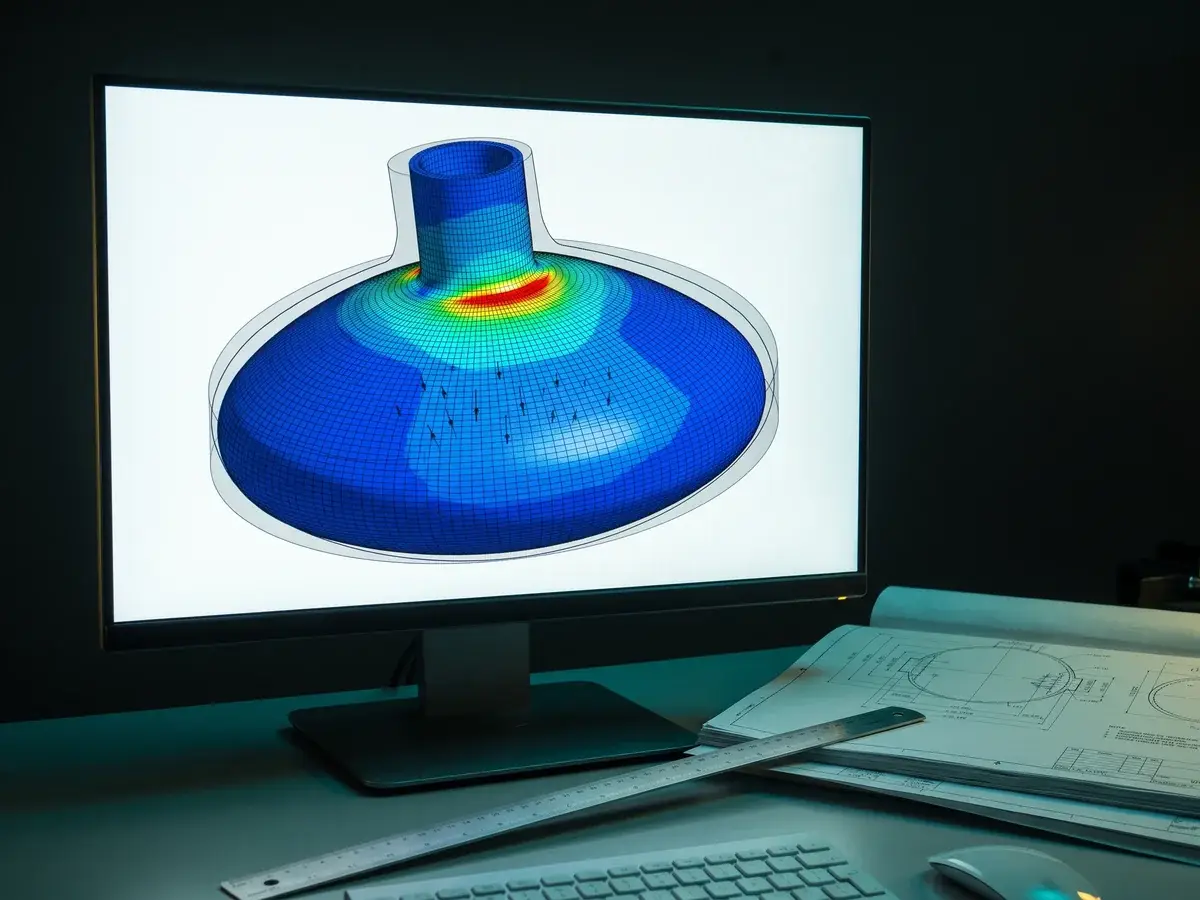
Nonlinear analysis FEA stress contour of a pressure vessel nozzle, with color bands showing where a thinner wall still holds

Pressure Vessel · Industrial Client

Thinner Walls, Same Code Margin

Before

Wall thickness set by conservative linear checks. Extra material on every vessel.

After

Elastic-plastic analysis to ASME BPVC Section VIII, Division 2 proved the real collapse margin.

15%

Thinner wall

Div 2

Design by analysis

0

Code margin lost

See Pressure Vessel Work
How We Work · Nonlinear FEA

How Our Nonlinear Analysis FEA Gets You To A Final Design

From Your Data To A Validated Design, With Your Approval At Each Gate

01
Assess
Magnifying lens over a teal CAD wireframe of a bracket on client drawings, the first review in a nonlinear analysis FEA job

We review your project scope and the CAD, loads, and history you have, and screen which nonlinearities matter.

02
Roadmap
Road winding past milestone markers to a gold flag, showing the scope, targets and gates of an FEA nonlinear analysis plan

Scope, targets, and gates, from where you are to where you need to be.

03
Engineer
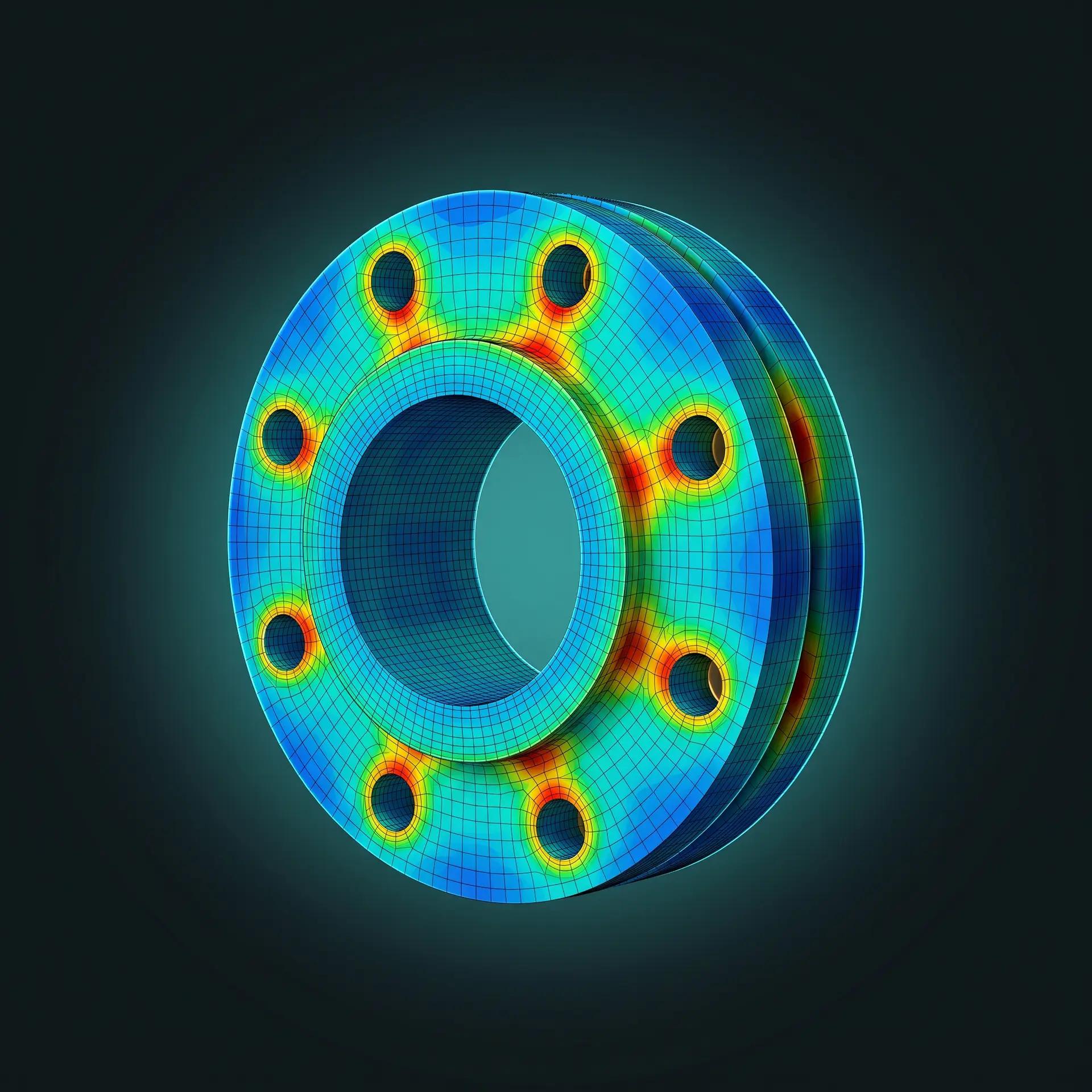
Nonlinear analysis FEA stress plot of a pipe flange, with red and orange bands around the bolt holes where contact loads peak

Nonlinear FEA and CAD iterations, with testing when needed.

04
Deliver
Design package with a bound report, drawings and a 3D CAD model of the part, delivered at the end of nonlinear analysis FEA

The design, drawings, and models, second-checked in our QMS.

05
Support
Hands holding up a machined bracket, showing the support PPS gives after delivering a design proven by nonlinear analysis FEA

We stand behind the design through production and supply issues.

PPS engineers run FEA, CFD, and DFMA as one loop. Nonlinear results set real margins, CAD changes follow, and manufacturing cost is checked before tooling. The design you approve is the design that ships, and the one you pay for once.

Linear-Only Vendor

Run It, Ship It, Hope

Outdated
  1. Linear Run

    Small-strain, elastic, bonded contact

  2. “Passes”

    Or add thickness until it does

  3. Build Prototype

    Tooling and test article paid for

  4. Yields Or Buckles Rework

    The failure shows up on the bench

  5. Redesign

    New geometry, new prototype, new test

You fund every loop
Every loop costs a prototype and a test
Pure Prime

Find The Real Limit

Recommended
  1. Screen

    Which nonlinearities matter here

  2. Nonlinear Model

    Plasticity, contact, buckling

  3. Optimize Our loop, not yours

    Geometry refined to real margins

  4. QMS Check Passed QC

    Second engineer verifies the model

  5. Validated Design

    Build once, to confirm

White paper data: 51% fewer prototypes
Build once, to confirm the real margin

Every prototype loop you fund is margin lost. Get a free roadmap.

Get Your Free Roadmap
Industry Applications

Nonlinear Analysis FEA Results In Your Industry

Aerospace Nonlinear Structural Analysis To Mining Equipment Loads

Aerospace Structures

Post-buckling and plasticity margins documented for review, so flight parts are both light and proven.

Lighter parts, proven.

Applications

Post-Buckling

Composites

Plasticity

Bolted Joints

See Aerospace Work

Automotive Crash Loads

Plastic strain and contact modeled before the first crash sled, so structures absorb energy as designed.

Pass the sled test once.

Applications

Crash Energy

Plastic Strain

Contact

Elastomers

Explore Automotive

Mining Equipment Loads

Impact, yield, and bolted-joint contact solved for buckets and frames that must survive remote duty.

Stop costly downtime.

Applications

Impact Loads

Weld Yield

Bolted Joints

Fatigue

See Mining Results

Marine & Subsea Loads

Hull panels and subsea housings checked for collapse and buckling under real pressure before the build.

Pass class review first.

Applications

Hull Collapse

Buckling

Subsea Housings

Class Rules

Explore Marine Work
Why PPS

Why Teams Choose PPS For Nonlinear Analysis FEA

Nonlinear FEA Consulting Specialists Who Stand Behind The Design

A Team, Not One Hire

FEA, CFD, CAD, DFMA, and testing under one roof. Engineering is a team sport, and you get the whole team.

One team, every skill.

Under One Roof

FEA

CFD

CAD

DFMA

Testing

Meet Our Engineers

SDVOSB Set-Aside Ready

Veteran-owned SDVOSB status gives defense and federal buyers a set-aside path to proven engineering.

Verify our SDVOSB status.

Credentials

SDVOSB

VOSB

CAGE 8ZK73

NAICS 541330

Verify SDVOSB Status

We Stand Behind It

Missed something in our QC? We fix it. Supplier can't make the part within three years? We fix that too.

Support for the long run.

We Fix

Our QC Misses

Supplier Gaps

Supply Chain

See How Clients Stay

Solutions, Not Hours

We price to the value we deliver, not hours logged. You buy a design that works, not more iterations.

Pay for the result only.

Collections

Gold

Platinum

Diamond

View Pricing Plans
FAQ

Nonlinear Analysis FEA Questions Engineers Ask First

Straight Answers On Scope, Data, IP, And What Happens If A Test Fails

When does my design need nonlinear analysis FEA instead of linear?

Linear Vs Nonlinear FEA: Five Signs Linear Is Not Enough

Your design needs nonlinear analysis FEA when a linear model can no longer describe how the part behaves near its limits. Linear FEA assumes small deflections, elastic material, and contact that never changes. Real parts break those rules. That is the difference between linear and nonlinear analysis in FEA. Watch for five signs. Stresses in your linear model exceed yield. Thin walls, shells, or struts carry compression and may buckle first. Bolted joints, seals, or press fits open, slide, or close under load. Rubber, plastics, or elastomers see large strains. Or the part is overbuilt because nobody could prove a lighter one.

Any one of these makes the linear number a guess. A guess turns into extra weight on every unit or a failure on the test bench. The NAFEMS nonlinear analysis resources explain when each effect matters. PPS reviews your project scope in a free assessment and tells you which nonlinearities your design actually needs. If a linear model is enough for your part, we say so and explain why.

Which FEA software and CAD formats do you work with?

ANSYS, Abaqus, And LS-DYNA With Native Or Neutral CAD Files

Our nonlinear analysis FEA work runs in ANSYS Mechanical, Abaqus, and LS-DYNA. We pick the solver that fits the physics. ANSYS nonlinear analysis and Abaqus handle plasticity, contact, and buckling with implicit solvers. Explicit dynamics in LS-DYNA covers impact and crash events. Tell us which solver your team uses. We accept native CAD from SolidWorks, CATIA, NX, Creo, Inventor, and Fusion 360, plus neutral formats: STEP, IGES, Parasolid, and ACIS. Broken geometry wastes time on many projects, because the mesh inherits every gap and sliver in the model. NIST's STEP File Analyzer can check a neutral file for errors before you send it.

We clean and check your geometry before meshing, so the analysis runs on the part you designed. If you already have FEA models, send them. We can review them, extend them to nonlinear, or rebuild them where the assumptions don't hold. For loads driven by vibration, our vibration analysis services work from the same models. Native model files are included at delivery, so your team can rerun any case.

What do you need from us to start?

Send Your Data And Targets; We Draft The Roadmap From There

To start a nonlinear analysis FEA project, send what you have, in whatever format your team already uses. That usually means CAD, native or STEP, and the loads or a description of how the part is used. Add material specs or test data, your targets, and any failure history. Missing data is a common reason engineering projects stall. A model built on guessed inputs gives a guessed answer, and a guessed answer can cost a prototype. That is why we don't start the work until every data set is in. For gaps in material data, NIST material measurement data is a good first stop.

Once your data is in, the first step is a free assessment of your project scope. We confirm what the work can and can't answer, and tell you what is still missing. Then we send a roadmap proposal with scope, targets, and approval gates. Every project is scoped on its own, so the roadmap sets the schedule, not a stock promise. NDAs are available before you share any files.

Who owns the design and the models?

The Design, Drawings, And Models Belong To You At Delivery

You own the IP from your nonlinear analysis FEA project by default, as set in your contract. That covers the design, the drawings, and the models. Some firms keep the models or license them back to you, so every later change sends you back to them, at their price. That locks your product to one vendor. It also makes design reviews harder, because your team can't open the evidence behind the decisions. Your customers may ask for that evidence too. Export-controlled programs add another layer. The State Department ITAR guidance sets the rules for defense data, and a loose handoff can break them.

At PPS, the IP transfers with the solution, and nothing is held back to tie you to us. You receive the native CAD, the drawings, the simulation model files, and the documented results. Your engineers can check the work, rerun a load case, or hand the package to a supplier. We sign mutual NDAs before any data is shared, and we match your export-control rules from the start.

What happens if a prototype fails in test?

If We Missed It In Our QC, We Fix It; Test Data Improves Design

If a prototype fails in test, we find out why and fix the design. With nonlinear analysis FEA from PPS, you approve the data at each gate. So a test result is checked against predictions you have already seen, not against a black box you can't open. Hard engineering carries unknowns. Real loads, material lots, and assembly effects never match a model perfectly. A failure in test is data, because it shows which assumption was wrong. That data improves the model and the design. NASA's standard for models and simulations sets out how to judge whether a model's results can be trusted.

When testing is in scope, our design validation services plan the test to confirm the margins that matter most. Then we correlate the model to the results. If the miss was ours, because something slipped through our QC review, we fix it. If the test finds a condition nobody knew about, we scope the change with you and update the roadmap. Either way, you get a clear answer.

How is a nonlinear analysis FEA engagement priced?

Priced To The Value We Deliver, Never To The Hours We Log

We price every nonlinear analysis FEA engagement to the value it delivers, not the hours we log. Hourly billing rewards extra iterations. The meter keeps running whether or not the design improves. So the cheapest quote can become the most expensive project once rework shows up. Federal buyers know this risk well. The Federal Acquisition Regulation notes that a time-and-materials contract gives the contractor no positive profit incentive for cost control or labor efficiency. Our incentive runs the other way: get the design right the first time. We engage by fit, not as a ladder, so you start where your need is.

Gold (from $35K): you have one project and need help with it. Platinum (from $15K/mo): you have recurring work at a steady rhythm. Diamond (from $800K/yr): you have a long development program, often multi-year. Gold is never required, and these are starting points, not quotes. We price to the value we deliver, not the hours we log. If the value isn't there for you, we'll say so in the assessment.

Not sure linear is enough? Send the model. Get a free roadmap.

Free Assessment. No Obligation. NDAs Available.

Get A Nonlinear Analysis FEA Roadmap For Your Design

Send Your Data. We Show The Path To The Lowest Total-Cost Design.

Send your CAD, loads, and targets. We review your project scope in a free assessment and reply within one business day with next steps.

SDVOSB Certified
VOSB Certified
CAGE 8ZK73
NAICS 541330

On-site assessments that require travel are quoted separately.