


Apply this method to your own program. Send data for a free roadmap.
Get Your Free RoadmapPublic benchmark · NASA, 2004
3–8x
In Design
21–78x
In Integration And Test
A NASA study found that a requirements error fixed during design costs 3 to 8 times as much as one fixed during requirements, and 21 to 78 times in integration and test (NASA, 2004).
Agency study of NASA and industry systems data. Baseline: the cost of fixing the same error during requirements. Source: NASA JSC, 2004. Not a PPS result.
Public benchmark · IEEE Spectrum, 1995
65%
Fewer Change Errors
+15%
Better Than Target
On the first airliner designed entirely on computer, digital pre-assembly eliminated 65% of change errors and rework, beating its target by 15% (IEEE Spectrum, 1995).
Trade-press report. Digital design and virtual pre-assembly, not FEA or CFD. Source: IEEE Spectrum, 1995. Not a PPS result.
The public record shows what the method can do. What it does for you depends on your constraint, and the assessment tells you.
Take a product from idea to launch through clear gates, with analysis and prototypes behind each decision.
Decide each gate on data.
Covers
Gates
Analysis
Launch
Prototypes and tests that confirm what the analysis predicted, built and run by our partner shops and labs.
Prove it before launch.
Covers
Prototypes
Launch
Tests
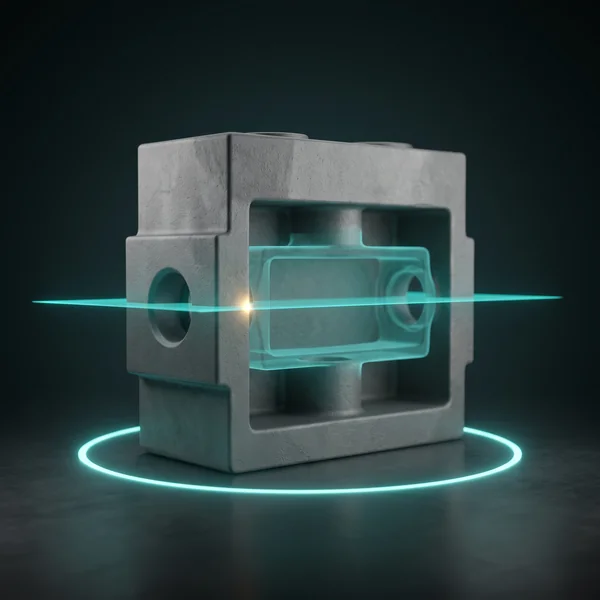
3D models and drawings a supplier can quote and build, with only the tight tolerances your design needs.
Drawings ready to quote.
Covers
3D CAD
Drawings
GD&T
What Will I Learn From The Product Design And Development Guide?
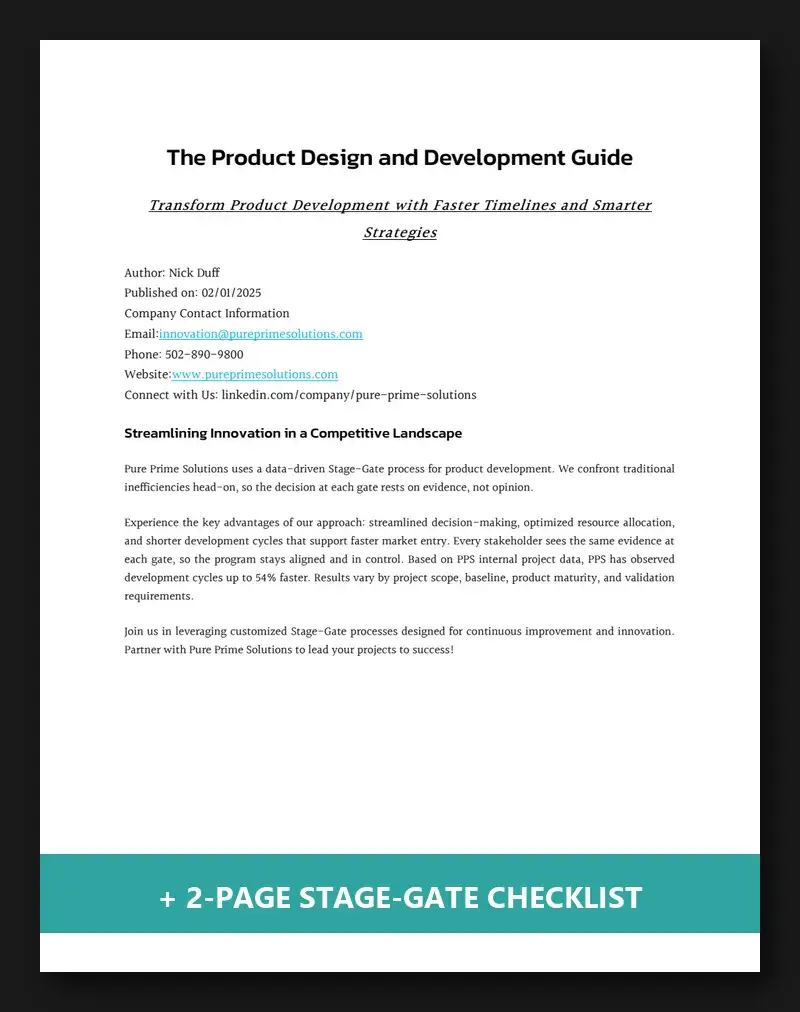
The product design and development guide is for engineering leaders, program managers and founders who run hardware programs. Many of them run gates already. Too often, though, each review turns into a status meeting, and nobody agreed in advance what the gate had to prove, or who decides.
A gate without criteria passes on hope. Open issues roll into the next stage, where they cost more to fix. Big agency programs plan for this. NASA's program life cycle sets phase boundaries as natural points for go or no-go decisions. A hardware program of any size can borrow the same simple discipline from day one.
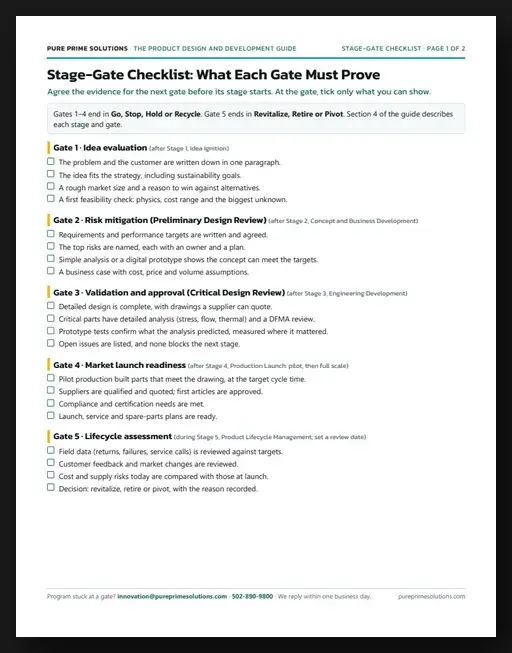
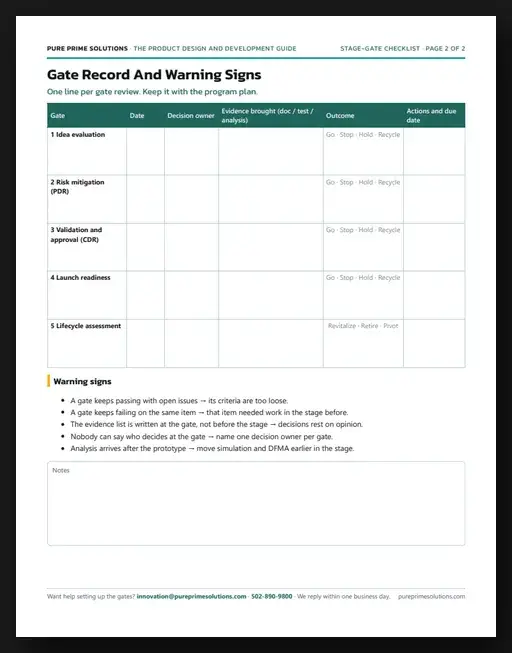
The download opens with a two-page Stage-Gate Checklist: what each of the five gates must prove, with fields for owner, outcome and date. The 10-page white paper shows why late design changes cost the most. It puts a gate before each round of spending, agrees go/no-go criteria up front and keeps one team in one loop. It ends with public research and results from our projects. Use it to set up a new program or tighten one already running.
What Happens After I Download The Product Design And Development Guide?
When you request the product design and development guide, we email the PDF to the address you enter. Check your spam folder if it doesn't arrive within a few minutes. That is all that happens. There is no sales call and no follow-up sequence unless you ask for one.
Many free downloads come with a catch: a call you didn't ask for, weeks of sales emails. US law sets a floor. The FTC says the CAN-SPAM Act requires senders to offer a way to opt out. We add you to our article emails only if you tick that box on the form, and you can unsubscribe in one click.
Our Privacy Policy explains how we use your details. If the guide raises a question about your program, reply to the email or use the contact page. Send the plans or drawings you can share. We sign a mutual NDA with you before you share any data. We reply within one business day. The first step is a free assessment that ends with a roadmap.
What should each gate prove in a product design process for manufacturers?
Each gate in product design and development should prove that the next stage is worth paying for. That means agreeing on the evidence before the gate, not at it. Programs that stall often skip this step, so every review becomes a debate about what counts.
If a gate keeps passing with open issues, its criteria are too loose. If it keeps failing on the same item, that item needed work in the stage before. Both patterns push problems downstream. A NASA study of error costs found the cost of a fix climbs at every later phase, so loose gates get expensive fast.
The early gates prove the problem and the concept: requirements written down, main risks named, and simple analysis that shows the concept can meet them. The middle gates prove the design, with detailed analysis, a DFMA review and prototypes that confirm the predictions. The late gates prove the product can be built and sold, with tests and supplier quotes. Stuck at a gate? Send us the plan today.