
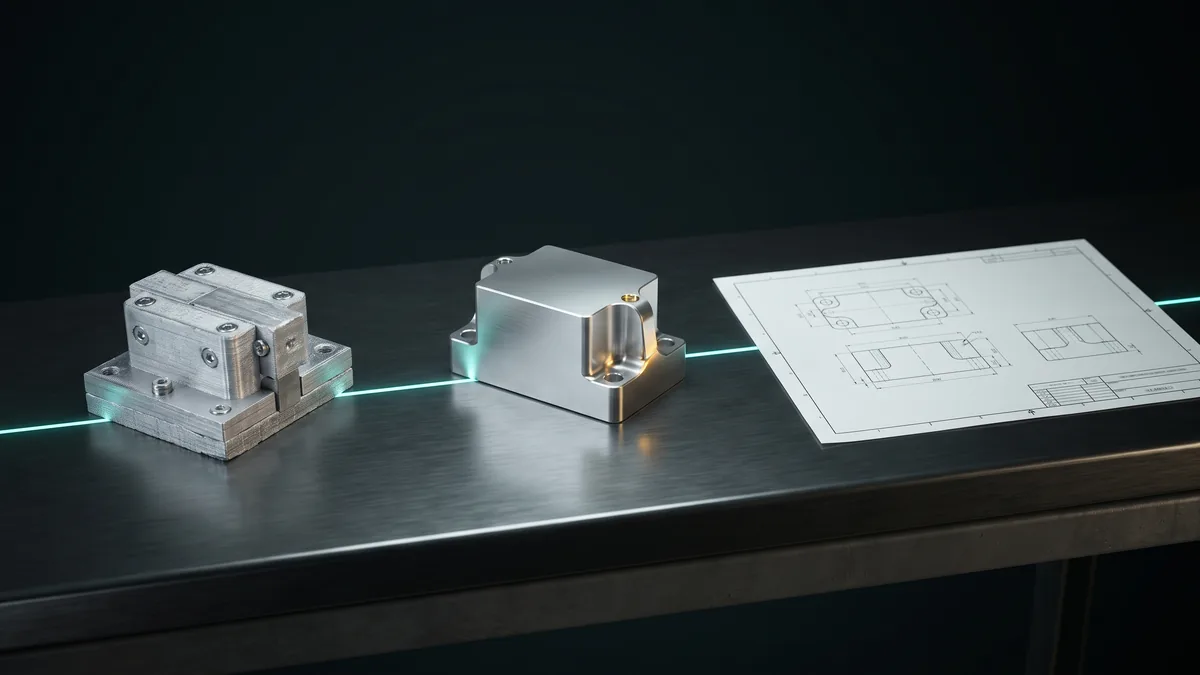
Cut part count and assembly steps so the design costs less to build at any qualified shop you choose.
Fewer parts, less cost.
Covers
Part Count
Assembly
Unit Cost
Build-ready CAD models and drawings, checked in our design QC, that your suppliers can quote and build.
Drawings ready to quote.
Covers
CAD
Drawings
Design QC
From concept to launch through stage gates you approve, with simulation and testing where the design needs it.
From concept to launch.
Covers
Concept
Stage-Gate
Testing
Late validation cycles delay vehicle launches across model-year gates.
Ready for the next gate.
Applications
EV Thermal
Crash
NVH
Single-point design failures ground fleets and trigger costly program reviews.
Find it before flight.
Applications
Flight FEA
Buckling
CFD
Bucket and structural failures shut down remote mines for days at a time.
Less downtime in the pit.
Applications
Wear
Fatigue
Heavy Haul
Failed classification reviews force long hull redesign and rework loops.
Built for class review.
Applications
Hull FEA
ABS / DNV
Hydro CFD
Who Writes These Articles, And Where Do The Methods Come From?
Engineers write every engineering design process article on this page. The people who run PPS projects write about problems they see in real designs. They cover what went wrong, how they checked it, and what they would do next time. The articles teach methods, not sales pitches.
PPS engineers run FEA, CFD, CAD, and DFMA in-house, with testing in-house, at a managed lab, or at your facility. Every design goes through our design QC, and the articles follow the same methods. Each post names its author and shows when it was last updated, so you always know who stands behind each method.
Nick Duff, Co-Founder & Chairman, CEO, is an aerospace stress engineer on flight-critical aerospace and defense programs. Tom Cushing, Co-Founder & CTO, is a licensed Professional Engineer (PE). He leads the tools, methods, and design QC our engineers use from assessment to delivery. You can read their backgrounds on our About page. Spot a mismatch with your project? Tell us, and we will look. We reply within one business day.
Can I Use The Methods In These Articles On My Own Designs?
Yes. Each engineering design process article explains the method step by step, so you can apply it to your own work today. It covers what to set up, what to check, and what a good result looks like. We write for practicing engineers who know the basics.
There is a limit, though. An article cannot see your loads, materials, schedule or drawings. The same method can mislead you when the inputs are off. That is why the NASA Systems Engineering Handbook builds reviews into every phase. When a design decision, a supplier dispute or a safety margin depends on the answer, get a second look.
Use the articles to plan your next project, to review a report from a supplier, or to train a new engineer. Then have the work checked by an engineer who can see the whole problem. Our free assessment is the first step. You send the data and we review your project scope. You get a roadmap that shows what we would check, change or test next, and why.
What Belongs On A Mechanical Design Review Checklist Before Supplier Quotes?
Before a design leaves the engineering design process for supplier quotes, check that a stranger could build it from the package alone, without calling you. Start with the drawing. Every feature that matters needs a dimension and a tolerance. Datums should match how the part is held and inspected.
Nothing should be over-toleranced without a reason, since tight tolerances drive cost. ASME Y14.5 gives suppliers one language for these callouts. Then check that the model and drawing agree, the material and finish are called out, and the revision is clear. A gap in any of these sends quotes high or far apart.
Run a quick DFMA pass: count the parts and ask whether each one needs to exist. Look for features that need special tooling or a second setup. Then send the package to one trusted supplier for comment before the quote round. If quotes come back high, send us the package. We reply within one business day, and the first step is a free scope assessment that ends with a roadmap.