

Apply this method to your own part. Send data for a free roadmap.
Get Your Free RoadmapPublic benchmark · IEEE Spectrum, 1995
65%
Fewer Change Errors
+15%
Better Than Target
On the first airliner designed entirely on computer, digital pre-assembly eliminated 65% of change errors and rework, beating its target by 15% (IEEE Spectrum, 1995).
Trade-press report. Digital design and virtual pre-assembly, not FEA; FEA and CFD apply the same principle to stress, heat and flow. Source: IEEE Spectrum, 1995. Not a PPS result.
Public benchmark · NASA, 2004
3–8x
In Design
21–78x
In Integration And Test
A NASA study found that a requirements error fixed during design costs 3 to 8 times as much as one fixed during requirements, and 21 to 78 times in integration and test (NASA, 2004).
Agency study of NASA and industry systems data. Baseline: the cost of fixing the same error during requirements. Source: NASA JSC, 2004. Not a PPS result.
The public record shows what engineering simulation can do. What it does for you depends on your constraint, and the assessment tells you.
Find stress, deflection and fatigue life before the first part is cut, with models checked by hand calcs.
Know the margin first.
Covers
Stress
Fatigue
Margin
Predict flow, pressure drop and heat transfer, so fans, ducts and coolers work before you build them.
See the flow early on.
Covers
Flow
Pressure
Heat
Couple heat, flow and structure in one model when one affects the other, and catch the failures it hides.
All the physics at once.
Covers
Thermal
Coupled
Flow
What Will I Learn From The Engineering Simulation Guide?
The engineering simulation guide is for design and analysis engineers, and the managers who sign off on their results. Most of them run models every week. The hard part is knowing when a result is good enough to act on, and when it needs a test.
A model with good graphics can still be wrong. Single-physics models can miss failures where heat, flow and load act together. Inputs are often scarce or noisy. NASA takes this seriously enough to publish a standard for models and simulations, with acceptance criteria set by each program. Many teams have no written rule at all.
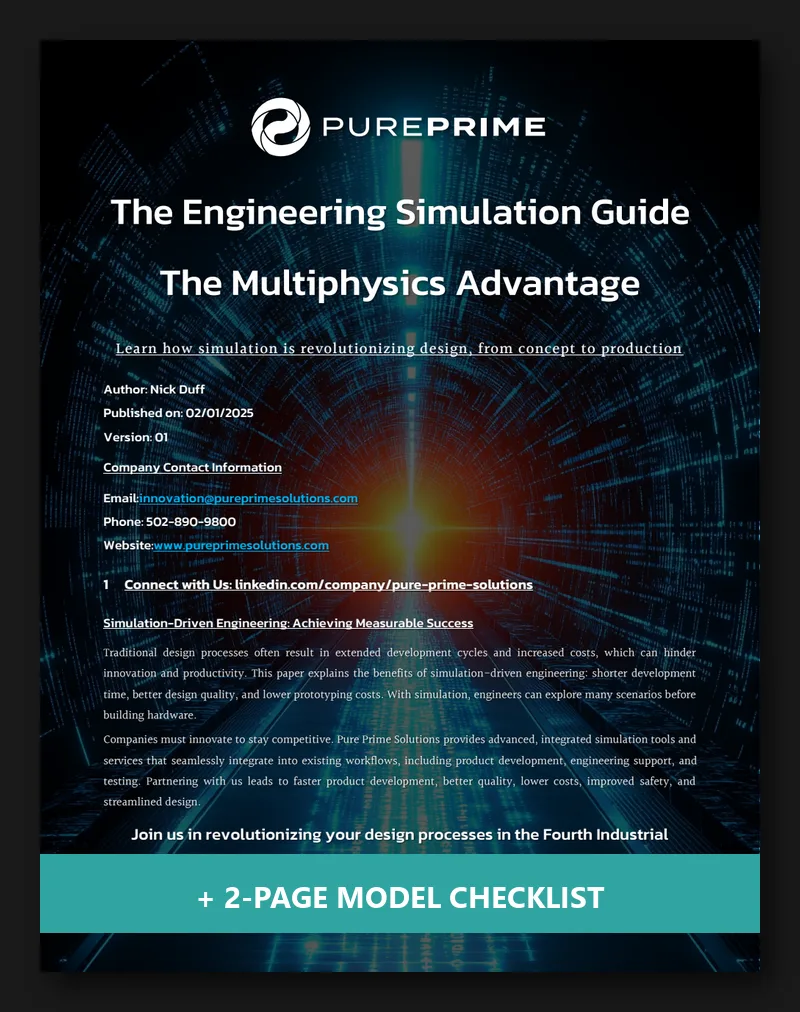
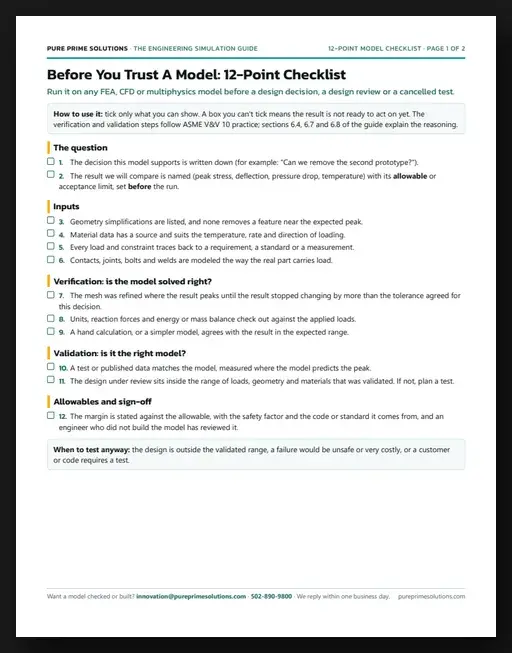
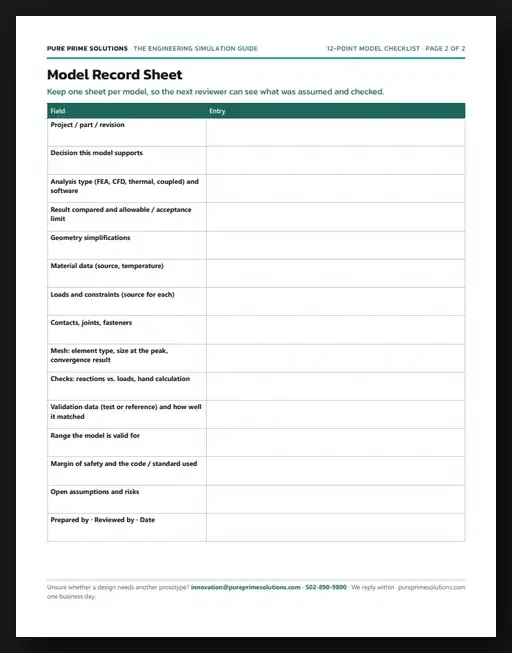
The download opens with a 12-point checklist to run before you trust a model, plus a model record sheet. The 12-page white paper shows why the prototype-test-fix loop eats your schedule. Its answer is to model, correlate, then prototype: find flaws while they are cheap, test what you can't afford to test and find the margin you are paying for. You don't need to be an analyst to use it.
What Happens After I Download The Engineering Simulation Guide?
When you request the engineering simulation guide, we email the PDF to the address you enter right away. Check your spam folder if it doesn't arrive within a few minutes. That is all that happens. There is no sales call and no follow-up sequence unless you ask for one.
Many free downloads come with a catch: a call you didn't ask for, weeks of sales emails. US law sets a floor. The FTC says the CAN-SPAM Act requires senders to offer a way to opt out. We add you to our article emails only if you tick that box on the form, and you can unsubscribe in one click.
Our Privacy Policy explains how we use your details. If the guide raises a question about your design, reply to the email or use the contact page. Send the drawings or models you can share. We sign a mutual NDA with you before you share any data. We reply within one business day. The first step is a free assessment that ends with a roadmap.
Simulation vs physical testing cost: when can a model replace a test?
Engineering simulation can replace a physical test only when the model has earned trust for that kind of design and load. Teams often skip that step. They run a new model, like the plot, and cancel the test, or they test everything and gain nothing from the model.
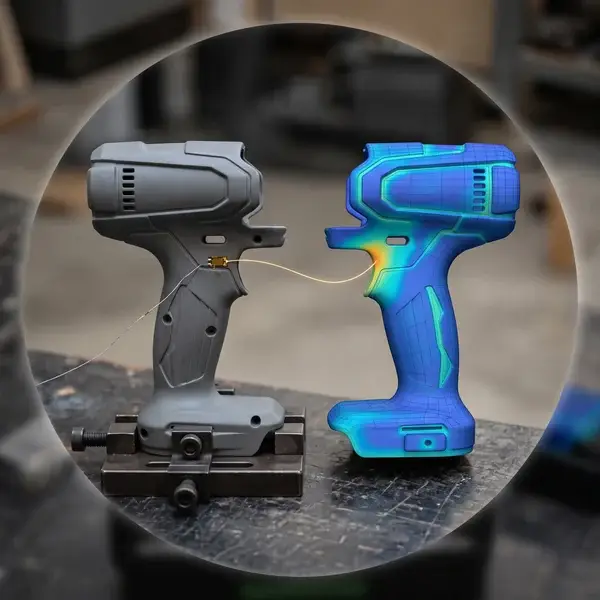
Both mistakes cost money. A cancelled test can let a failure reach the field, where it is unsafe and costly. Testing every variation wastes the time the model could have saved. Trust comes from verification and validation. Verification checks that the model solves its equations correctly. Validation checks that it matches a test on a real part.
A practical plan uses a few well-instrumented tests to validate the model, then lets the model explore the variations. Once validated, similar designs under similar loads often need fewer tests. Test again outside that range, or when a code or customer requires it. Standards such as ASME V&V 10 describe this process. Unsure about your design? Send us the model. We reply within one business day.