
Calculate, Build, Hope
Outdated- Hand Calcs
Average velocity, assumed losses
- “Passes”
Or oversize until it does
- Fabricate
Internals built and installed
- Startup Problems Rework
Uneven flow, noise, or erosion
- Redesign
New internals, new startup
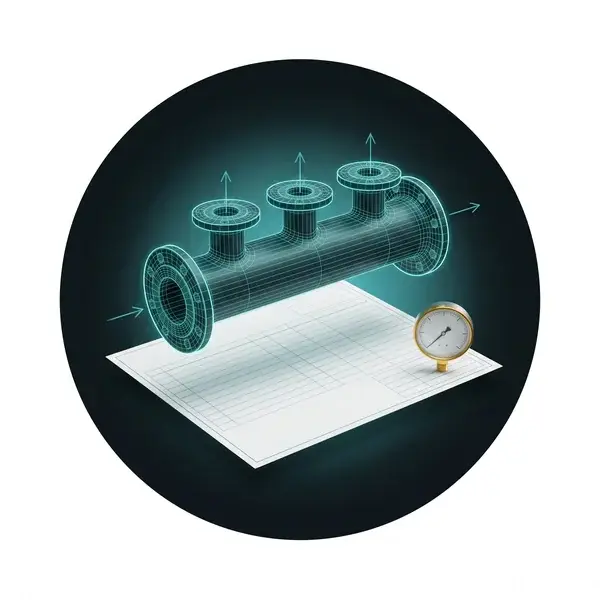
Hand calculations give average velocities and pressure drops. Real equipment has bends, branches, and internals that push the flow where it wants to go. When the flow isn't modeled, teams oversize pumps, fans, and pipe to be safe.
They pay for it in energy every year. Or they find the problem at startup, where uneven flow, noise, or erosion means rework and downtime.
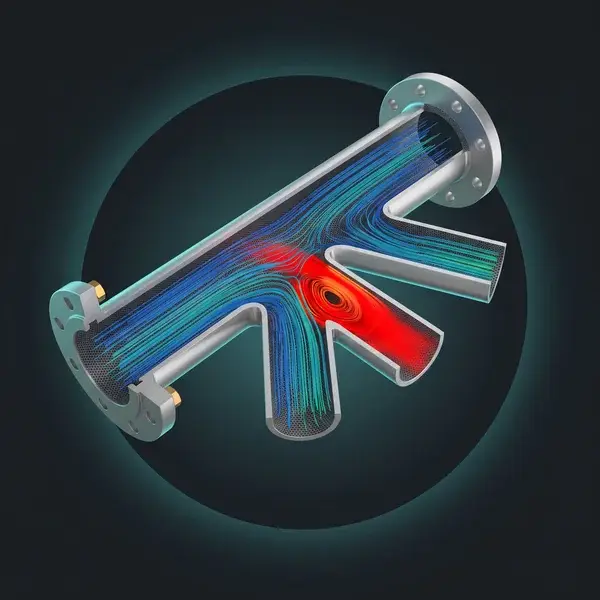
Fluid flow simulation models the flow inside your pipes, ducts, vessels, and machines. You see uneven flow, recirculation, and losses before anything is built. Then we change the design on screen, not on site, so the equipment is built once.
✓
A pressure drop problem in a piping system makes pumps draw more power than planned
Pressure drop beat the hand calculation.
✓
Flow is uneven across filters, beds, or nozzles
Some paths starve while others carry the load.
✓
Pipes or ducts show noise, vibration, or erosion
High local speed wears the equipment.
✓
Mixing takes too long or never finishes
Dead zones leave product out of spec.
✓
Equipment underperforms after scale-up
A design that worked small acts differently large.
✓
Pipe, pumps, and fans were sized up just in case
You pay for that capacity every year.
Cost you carry
Decision it lets you make
Result
Unit cost
Material & weight
Decision
Find the real pressure drop and where it comes from, then size drives to the real duty
→
Result
Smaller drives and lower energy, with margin kept
Development
Prototypes & testing
Decision
Predict flow, mixing, and losses before fabrication; use startup data to confirm
→
Result
Fewer changes at startup
Tooling
Rework & redesign
Decision
Find the hot spot in the model and fix internals before they are built
→
Result
Internals built once
After launch
Field failures & warranty
Decision
Model real operating ranges and fluids; release with documented results
→
Result
A design you can defend in review
01
A design that meets your loads at the lowest total cost, delivered as production-ready CAD and drawings
02
FEA results and margins you review and approve at each gate, before anything moves to prototyping.
03
You own the IP by default, set in your contract.
04
If we missed it in our QC, we fix it. If your supplier can't make the part within three years, or supply dries up, we fix that too.
You send
What we need to start
CAD, native or STEP
Loads and operating conditions, or how the part is used
Material specs or test data, if you have it
Targets: weight, cost, life, or code
Failure history, if a part already failed
→
You get
What you hold at the end
The optimized design: CAD and drawings ready for production
Models and results you reviewed and approved
Documented margins or code compliance
Test correlation, when testing is in scope: a partner lab or yours
A roadmap for what comes next, and a team that stays with you
We price to the value we deliver, not the hours we log. If the value isn't there for you, we'll say so in the assessment.
Every startup surprise you fund is margin lost. Get a free roadmap.
Get Your Free RoadmapMixing tanks, reactors, and transfer lines modeled so every batch blends evenly and stays inside spec.
Every batch in spec.
Applications
Mixing
Reactors
Scale-Up
Bolted Joints
Ducts, dampers, and cooling water systems balanced so the equipment sees the flow it was designed for.
Fewer forced outages.
Applications
Ducts
Dampers
Cooling Water
Elastomers
Inlet ducts and turning vanes tuned so scrubbers and baghouses get even flow across every single module.
Controls that perform.
Applications
Turning Vanes
Ductwork
Scrubbers
Fatigue
Intakes, piping, and hull appendages modeled for pressure drop, cavitation risk, and flow-induced noise.
Fewer surprises at sea.
Applications
Intakes
Piping
Cavitation
Class Rules
FEA, CFD, CAD, DFMA, and testing under one roof. Engineering is a team sport, and you get the whole team.
One team, every skill.
Under One Roof
FEA
CFD
CAD
DFMA
Testing
Veteran-owned SDVOSB status gives defense and federal buyers a set-aside path to proven engineering.
Verify our SDVOSB status.
Credentials
SDVOSB
VOSB
CAGE 8ZK73
NAICS 541330
Missed something in our QC? We fix it. Supplier can't make the part within three years? We fix that too.
Support for the long run.
We Fix
Our QC Misses
Supplier Gaps
Supply Chain
We price to the value we deliver, not hours logged. You buy a design that works, not more iterations.
Pay for the result only.
Collections
Gold
Platinum
Diamond
When does my equipment need fluid flow simulation?
Your equipment needs fluid flow simulation when the shape of the flow, not only its average, decides how well it works. Hand calculations assume flow spreads evenly. Real bends, branches, and internals push it to one side. That is where flow dynamics, not pipe size, set the result you get. Watch for four signs. Pumps or fans draw more power than planned. Flow is uneven across filters, beds, or nozzles. Pipes show noise, vibration, or erosion. Mixing is slow or never finishes. Each one costs you energy every year, or rework at startup. Piping codes such as ASME B31.3 still set the limits your design must meet.
In a free assessment, we review your project scope and process data and show where flow drives the risk. If a hand calculation is enough, we say so. If not, CFD analysis maps the real flow, pressure, and mixing before fabrication. Our engineers then fix the internals on screen, not during startup. Where heat moves with the flow, our heat transfer solutions extend the same model.
Which CFD software and file formats do you use?
Our fluid flow simulation work runs in ANSYS Fluent, STAR-CCM+, and OpenFOAM, three widely used solvers. Process simulation software treats each unit as a box with an inlet and an outlet. Computational fluid dynamics consulting services look inside the box, where the losses, swirls, and dead zones actually are. The wrong model gives a confident but wrong answer. A steady model can miss flow that changes with time. A single-phase model can miss the gas, liquid, or solids that drive wear. Broken CAD wastes time too, because the mesh inherits every gap. Good results also need good fluid data, such as the NIST fluid property tables.
We pick the solver and models that fit the physics: turbulence models for the flow regime, multiphase models, and transient runs when needed. Rotating machines, porous media, and particle tracking are covered too. We accept native CAD from SolidWorks, CATIA, NX, Creo, and Inventor, plus STEP and Parasolid. Send existing models and we review or rebuild them. Native model files come back to you at delivery.
What do you need from us to start?
To start fluid flow simulation work, send what you have, in any format. That usually means CAD, native or STEP, plus flow rates, fluids, temperatures, and pressures for each operating case. Add your targets for pressure drop, flow balance, or mixing, and any startup data or failure history. Missing data is the most common reason engineering projects stall, and it costs you time. A model built on guessed inputs gives a guessed answer. Guessed material and fluid data is a common gap, and NIST material measurement data is a good first stop. That is why we don't start the work until every data set is in.
Once it is, the first step is a free assessment of your project scope and data. We confirm what the work can and can't answer, and tell you what is still missing. Then we send a roadmap proposal with scope, targets, and approval gates. Every project is scoped on its own, so the roadmap sets the schedule, not a stock promise. NDAs are available before you share files.
Who owns the design and the models?
You own the IP from your fluid flow simulation project by default, set in your contract. That covers the design, the drawings, and the models. Some firms keep the models, or license them back to you, so every later change sends you back to them and their rates. That locks your equipment to one vendor for its whole life. It also makes design reviews harder, because your team can't open the evidence behind each decision. If your program falls under export rules, data handling matters too. The State Department's ITAR guidance sets the rules for defense data, and a loose process puts you at risk.
At delivery, you receive the native CAD, the drawings, the model files, and the documented results. Your engineers can check the work, rerun a case, or hand the package to a supplier or customer. We sign mutual NDAs before any data is shared. Your files stay in controlled project folders. Tell us your export or customer data rules at the start, and we set up handling to match.
What happens if the installed system doesn't perform as modeled?
If equipment designed with fluid flow simulation doesn't perform as modeled, we find out why. Real operating conditions, fluids, and assembly effects never match a model perfectly on day one. Because you approve the data at each gate, a test result is checked against predictions you have already seen. A failed test feels like a setback, but it is useful data. It shows which assumption was wrong: an operating case, a fluid property, or a boundary condition. Without a plan, that data gets argued over instead of used to fix the design. The ASME V&V 20 standard sets out how to judge CFD against test.
When testing is in scope, we plan it with a partner lab to confirm the flows and pressures that matter most to you. Then we correlate the model to the results. If the miss was ours, because something slipped through our QC review, we fix it. If the test finds a condition nobody knew about, we scope the change with you and update the roadmap together.
How are fluid flow simulation services priced?
We price fluid flow simulation services to the value they deliver, not the hours we log. Hourly billing rewards extra iterations. The cheapest quote often becomes the most expensive project once rework and field failures show up. Our incentive is to get the design right the first time. We engage by fit, not as a ladder, and you can move between them. Gold (from $35K): you have one project and need help with it. Platinum (from $15K/mo): you have recurring work at a steady rhythm. Diamond (from $800K/yr): you have a long development program, often multi-year. Federal buyers can also use the SBA's SDVOSB set-aside program.
Gold is never required, and some clients start at Platinum or Diamond. These are starting points, not quotes or bids. Your price comes from the free assessment, where we review your project scope and goals and send a roadmap proposal with scope and cost. We price to the value we deliver, not the hours we log. If the value isn't there for you, we'll say so in the assessment.