
What FEA stands for: how a model takes an input and produces a stress estimate, and what a result can and can’t prove.
Key Points
- FEA tells you how a design is likely to behave; the engineer still has to decide what that means.
- The model setup and the assumptions that go with it dictate what an FEA result can legitimately be said to support.
- A defined workflow links the idealization, the mesh, the loads, the checks and the interpretation.
- The solver is rarely wrong. The setup is.
A color contour plot appears on the shared screen during a design review, and the room goes quiet. To some, the hot spot is alarming. To others, it’s comforting. So what does the model actually represent?
That question gets at the real FEA meaning. Finite element analysis (FEA) represents a physical system as a mesh of finite elements. It then solves equations over that discretized model to predict how the system responds to the stated conditions. The contour on the screen is a computed prediction, not a measurement.
To show the FEA meaning in practice, this article follows the whole process: physical question, idealization, mesh, loads and restraints, solution, the model checks and the interpretation. Interpretation is where the engineering judgment comes in.
FEA Meaning Starts With a Discretized Physical Model
What Is Finite Element Analysis?
So what does that contour plot mean? It’s a computed field: the model’s stress at each point, under stated loads. The finite element analysis meaning comes down to one idea: FEA replaces a continuous system, with an infinite number of points, with a finite number of elements. Each element has its own equations that describe its response. The solver assembles those into one system and solves it.
The output is a model prediction, not a direct observation of the physical system. A contour, deflected shape, or predicted frequency is the model’s response to particular conditions. The same geometry can give different outputs when the inputs change. You have to read the FEA as a prediction and then decide what that prediction means.
That’s why FEA is so useful for stress, thermal and dynamic analysis etc. It is not a cure-all though. The discretized model gives you a way of systematically looking at how a design might respond to the conditions you’ve defined.
You can read more in our CFD and FEA simulation insights and structural analysis resources. FEA does not replace verification, validation, inspection, or physical testing. It frames the question so later steps have something to verify. Ansys technical documentation and US Federal Highway Administration material describe this approach.
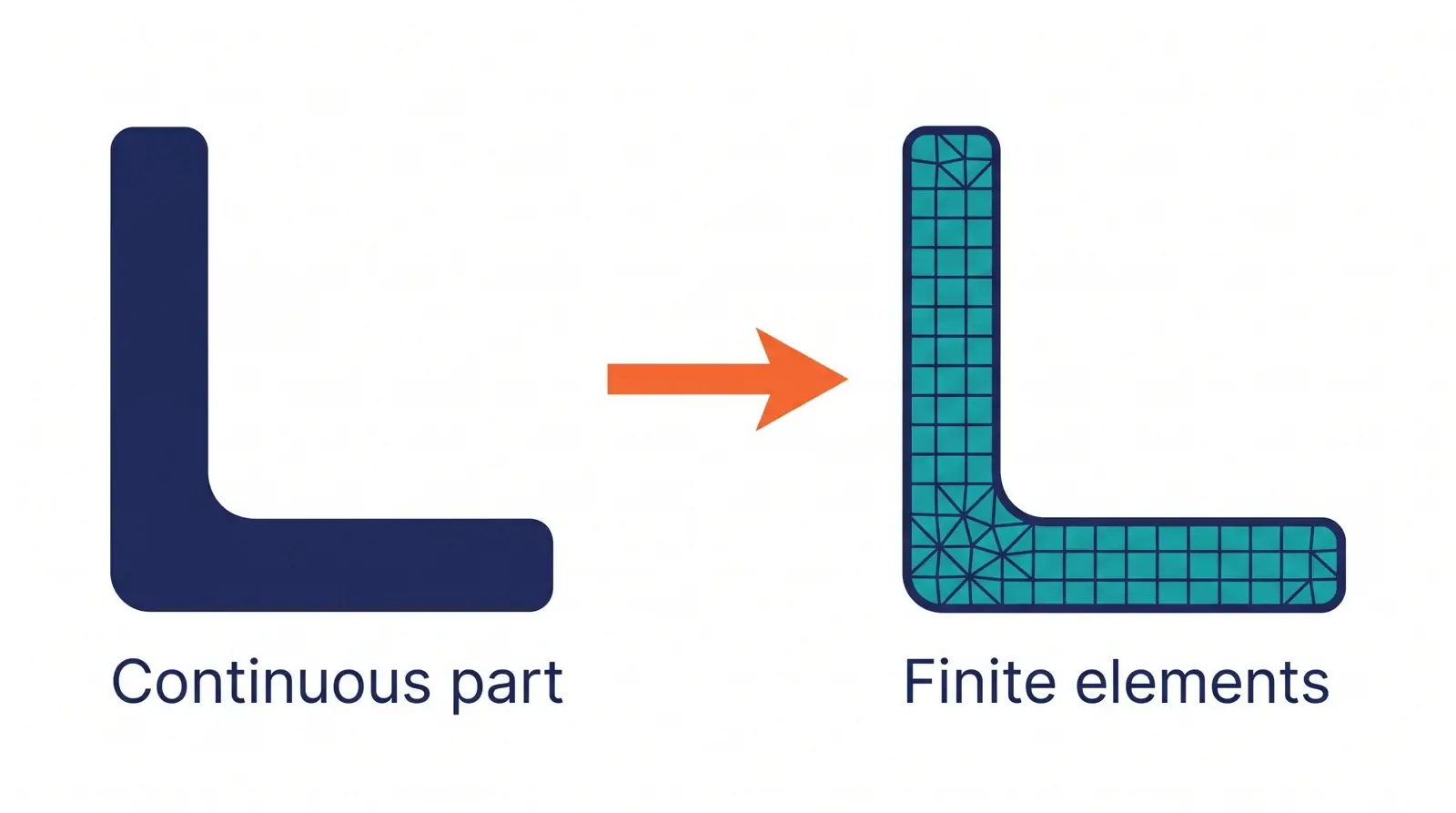
FEA meaning in one picture: a continuous part becomes a finite number of elements. Illustrative diagram.
Build the Model From Question to Checked Solution
A finite element model is only as good as the decisions behind it. You have to work from a well-defined question to a checked solution rather than straight to a picture. The inputs form a linked chain and each one will in turn alter the next estimate. At the highest level, the sequence is:
Model-construction process flow:
Physical question → Idealization → Meshing → Loads and restraints → Material definition → Solution → Model checks → Interpretation
Each stage feeds the next. Model checks can send the work back to an earlier stage before you interpret the results.
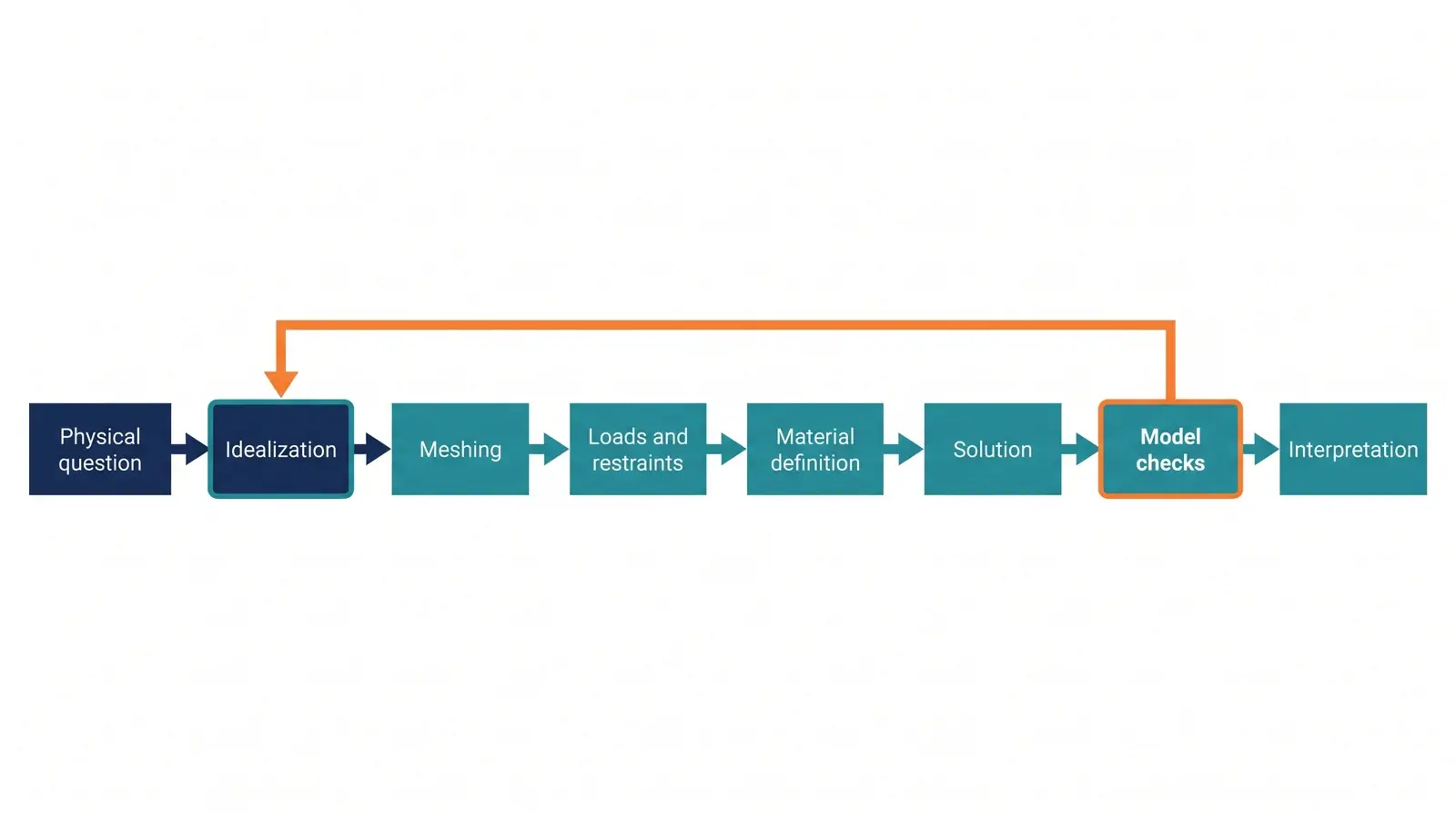
Each stage feeds the next, and model checks can send the work back. Illustrative diagram.
| Step | Representative inputs | What it shapes |
|---|---|---|
| Idealization | Geometry, model simplifications | What the model includes or omits |
| Meshing | FEA mesh density, element selection | How the geometry is discretized |
| Loading | FEA loads and restraints, boundary conditions in FEA | How the system is driven and held |
| Material | FEA material properties | How the material responds in the model |
| Solution and checks | Mesh checks, model-dependent assumptions | Whether the result is usable |
Model idealization comes first. You decide what geometry to keep, simplify, or remove so the model answers the physical question without extra detail. The FEA mesh discretizes that geometry. Mesh density and element type affect how well it captures shape and response. The loads and restraints determine how the system is driven and held. The boundary conditions have a significant effect on the response. Material definition provides the FEA material properties that connect loading to response. That’s why model checks and engineering judgment are still critical. To see where a study fits, look at PPS Finite Element Analysis Services. NASA’s observations on FEA practice warn against blind acceptance of results.
How FEA Reveals Patterns That Deserve Review
Once the setup and model checks are complete, ask: how does FEA reveal design risks? FEA can reveal modeled stress, strain, displacement, or vibration patterns that deserve closer engineering review under defined scenarios. Stress analysis, strain analysis, displacement analysis, and vibration analysis each show a different response for the scenario. The real value is direction: the results show you which responses deserve a detailed engineering review rather than a quick glance.
That value holds only within the stated limits, because the result depends on the model’s inputs and assumptions. Each result is model specific. A result is a question, not an answer. It varies with the scenario, so the scenario must be part of the result. Go back to the inputs and assumptions, and ask whether they represent the question well enough to trust the result. For dynamic responses, see vibration analysis. For coupled effects, see thermal stress analysis. Within the application’s scope, the result is a prompt to engineering judgment, not a conclusion.
Before you treat a modeled result as a conclusion, ask what inputs and assumptions led to it. The same output can mean different things depending on how sound those inputs and assumptions are. You can’t read the FEA meaning from the plot alone.
Why FEA Results Depend on Inputs and Assumptions
What affects FEA results? Every input does. The solver is rarely wrong. The setup is. The solver computes correctly from what you give it. If your assumption is wrong, you get the exact answer to a slightly different question. That’s the part of the FEA meaning that gets skipped in a busy review.
Model-Dependent Result
FEA results are conditional on the model’s geometry, loads, restraints, material data, element choices, mesh, and analysis assumptions, so model checks and engineering judgment remain essential. This list is not exhaustive, and the checks you need vary by model, software, application, and decision. The point is not to discard FEA but to recognize that every result depends on the model.
Take a flat plate with a square cutout, held on one edge and pulled on the other. In one software vendor’s published example (vendor-reported), a finer mesh about doubled the peak stress at the corner, and the peak kept climbing as the elements shrank. A short distance from the cutout, the stress barely changed. That corner peak came from the sharp corner in the model, not from a stress you could design to. So model the fillet or read the stress away from the corner. If fatigue matters, model the fillet with a fine mesh, because that’s where cracks start.
That’s the FEA meaning in one small example: same part, same load, and a peak that depends on the mesh.
Source: COMSOL, “Singularities in Finite Element Models: Dealing with Red Spots” (2015).
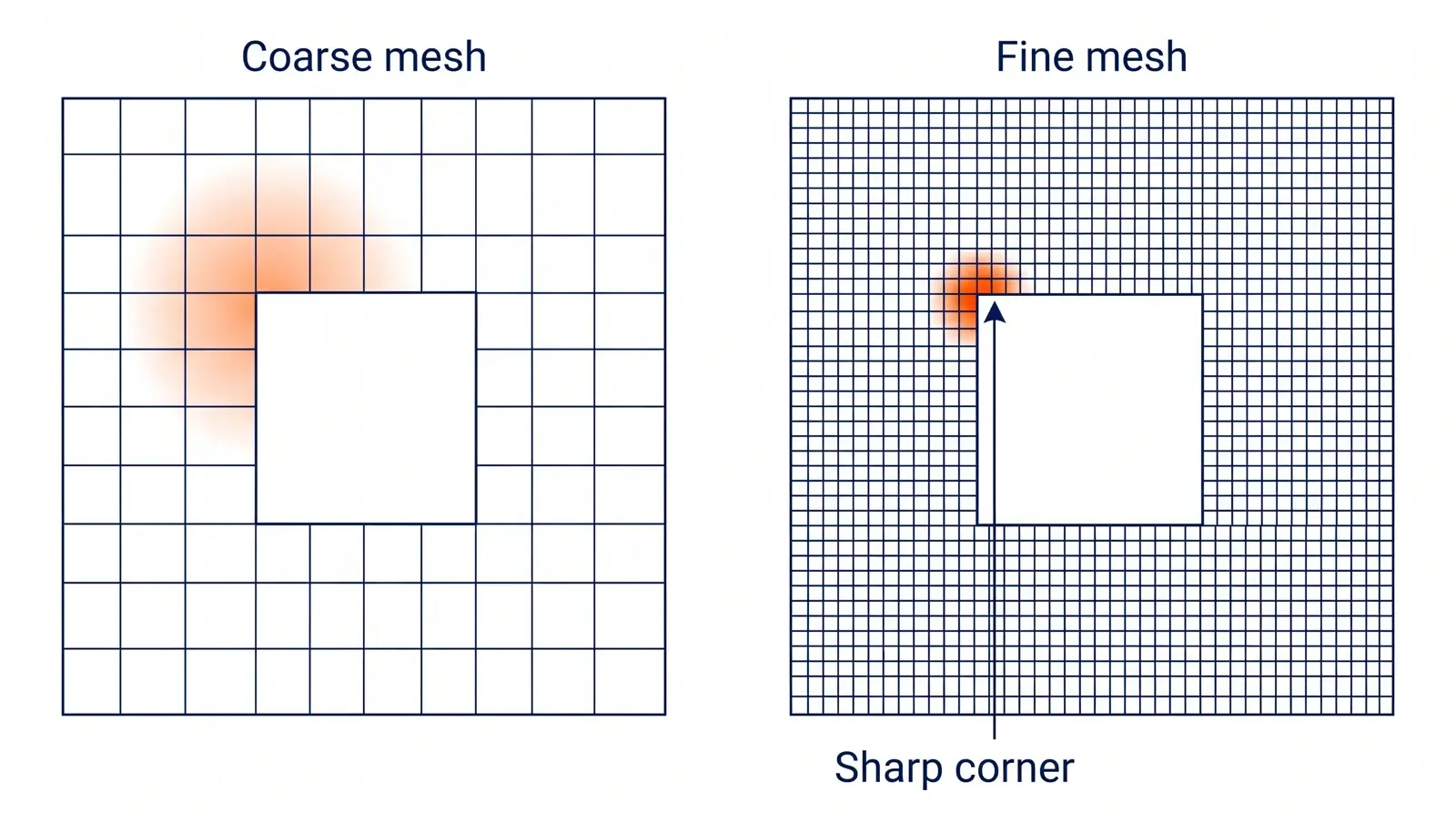
A finer mesh raises the peak at a sharp corner, while the stress a short distance away barely changes. Illustrative diagram, not a test result.
A misread contour costs you money both ways. If you chase a false peak you’re adding material that you pay for on every part. If you go on the basis of a number the model can’t support, the problem may not show up until testing. Every redesign is then going to eat into your prototype budget and your schedule. Less material and fewer prototypes also mean less waste.
When I review a stress hot spot, I use a mesh convergence check to help determine whether it represents a real stress concentration or a numerical singularity.
Model verification is a deliberate step, not something you do only at the end (NASA even has a procedure for verifying finite element models). Such procedures are specific to the application, the software, and the time. No single procedure, element type, or mesh size works in all cases.
Engineering judgment in FEA connects the checks to the final decision. It helps you decide which simplifications fit the problem and which need more review. Analysis reduces uncertainty but doesn’t eliminate it and testing is still required to confirm the result. The choice between linear and nonlinear FEA is itself an assumption which you have to check. Each decision should lead to the next step and tell you what further evidence you need. Without that judgment, the FEA meaning shrinks to a color plot.
Interpret Results Without Overstating What They Prove
Before you use a modeled result to make a decision, ask a short list of questions. They test the FEA meaning against the decision in front of you. First, representation: does the model capture the geometry, loads, restraints, and material behavior that matter to the question? Has simplification changed the problem? Second, support: what exactly does the result support? It supports a modeled estimate under defined conditions, not observed performance.
Third, evidence. A modeled result can support a focused engineering review, a design change, or a specific test. On its own, it rarely settles safety or compliance. Where a code accepts analysis, the model must meet that code’s rules. Ask what test still has to confirm before the decision moves ahead. Keep verification and validation separate. Verification shows the model was solved correctly. Validation shows it represents the real part.
- ☐ Representation: does the result match the question being asked, or has a simplification in the model changed the problem?
- ☐ Support: what does the result actually support? (A modeled estimate under defined conditions, not observed performance.)
- ☐ Evidence: what application-specific verification, validation, inspection, or physical testing remains before the decision moves forward?
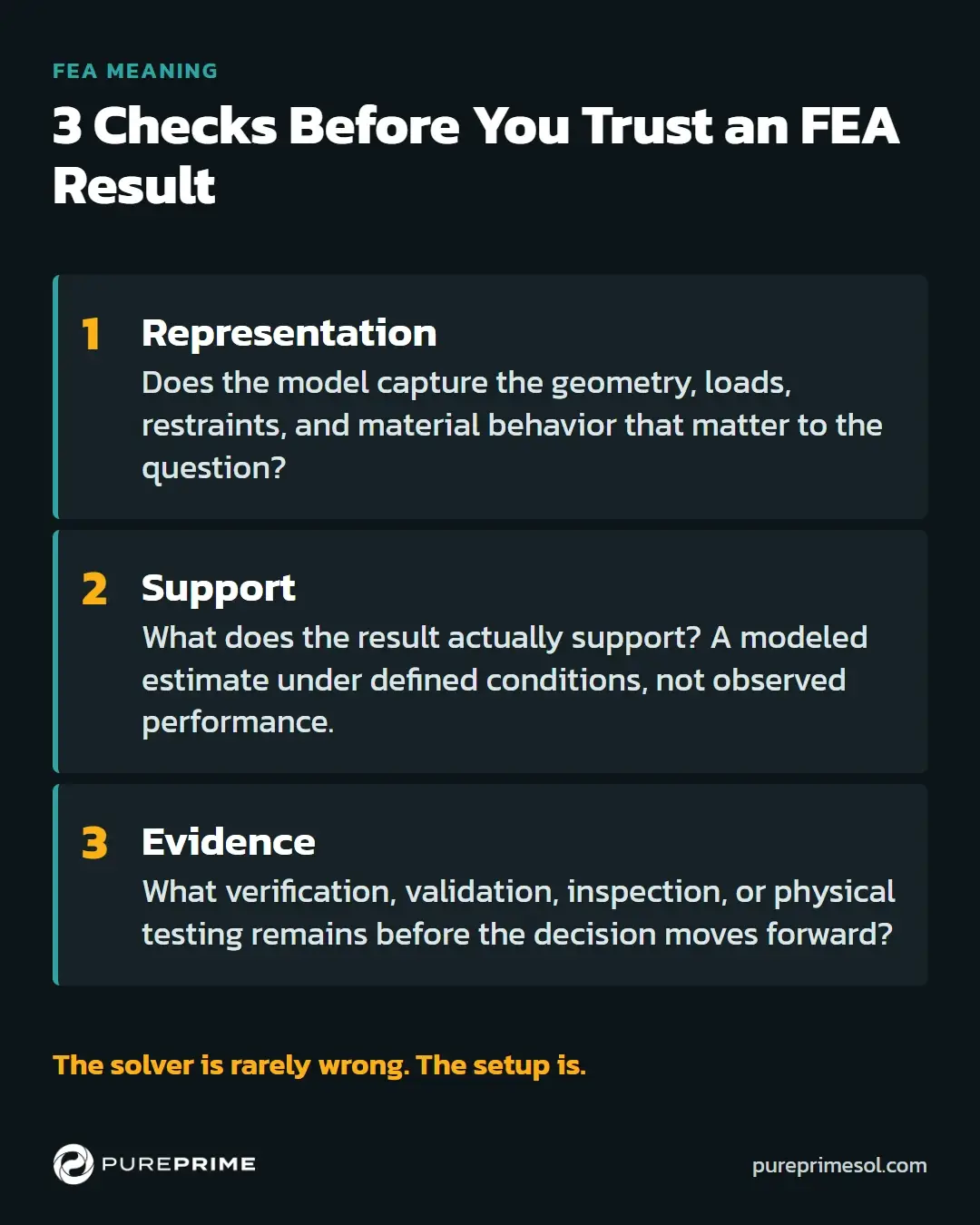
The FEA meaning for a design review, in three checks you can save.
Communicating results this way keeps the design review honest. It also keeps the FEA meaning clear for people who didn’t build the model. State the assumptions behind the estimate and name the scenario. Separate what the model has shown from what the team still needs to confirm. A short record of inputs, checks, and open questions is more useful in a review than a single contour screenshot. That discipline lets FEA focus attention and drive the next question, without asking it to prove something it was never meant to prove.
FEA Meaning: Common Questions
What does FEA stand for?
The short FEA meaning: FEA stands for finite element analysis. It represents a physical system as a mesh of small elements. It then solves equations over that mesh to predict how the system responds to loads and other conditions.
What’s the difference between FEA and FEM?
The finite element method (FEM) is the mathematical method. FEA is the use of that method to analyze a real part or system. Many engineers use the two terms interchangeably. The FEA meaning rarely changes when someone says FEM.
What is FEA used for?
Engineers use FEA to estimate stress, strain, displacement, temperature, and vibration before building hardware. It helps compare designs, find likely problem areas, and decide what to test. It doesn’t replace physical testing.
Conclusion
Back to that still moment in the design review. The hot spot may be a real stress concentration. It may also be a sharp corner in the model, and that peak will keep climbing every time you refine the mesh. So before anyone reacts, refine the mesh. If the peak converges, it’s real. If it keeps climbing, it’s a singularity, so model the actual fillet.
The contour on screen is not the final word. It is an estimate, shaped by every modeling decision you made. If you read it that way FEA can take you to the responses that you should be looking at. It is important to be clear that the result is dependent on the model inputs and assumptions; each result is conditional. That’s what FEA meaning comes down to in a design review. Say what the model shows, what it assumed, and what test still has to confirm.
PPS delivers the lowest total-cost design that removes your constraint, and stays with you after it ships.
Related Resources
- Linear and Nonlinear FEA Analysis: when a linear model isn’t enough.
- Thermal Stress Analysis: how heat drives structural response.
- Vibration Analysis: how a design responds to dynamic loads.
- Structural Analysis Methods: how PPS approaches structural modeling.
